


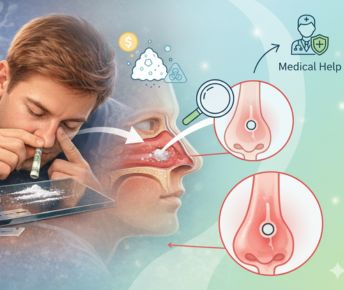



If you’ve ever heard someone casually joke about “coke nose” or cocaine nasal septum damage, it’s usually said the way people talk about hangovers, like it’s uncomfortable but temporary. The reality is far more serious.
Cocaine can cause permanent damage to the inside of the nose, including the nasal septum (the cartilage-and-bone wall that separates the nostrils). This isn’t rare, and it isn’t only something that happens to “heavy users.” It happens because of what cocaine does to blood vessels, tissue oxygenation, immune response, and the fragile lining inside the nose , and repeated use stacks that damage like interest.
This article breaks down exactly how it happens, what the warning signs look like, what makes it worse, and what recovery actually involves , in plain language, without scare tactics, and without pretending this is just cosmetic.
First: What the Nasal Septum Actually Does
The septum isn’t just “the wall between nostrils.” It helps control airflow and supports the shape of the nose. The front part is cartilage, which has a limited blood supply. That detail matters because cartilage doesn’t heal the way skin does. When it’s damaged repeatedly, it doesn’t “bounce back.” It deteriorates.
Now add cocaine.
Why Cocaine Causes Severe Nasal Septum Damage
When people snort cocaine, it doesn’t just sit there harmlessly. Cocaine is a powerful vasoconstrictor , meaning it tightens blood vessels. That effect is part of why the high feels sharp and intense.
But in the nose, tightened blood vessels mean reduced oxygen and reduced nutrient delivery to tissue. Imagine tissue repeatedly being “starved” and then asked to heal. It can’t keep up.
That’s why cocaine effects inside the nose often start with dryness and irritation and progress into chronic inflammation, ulcers, infection risk, and structural breakdown.
This is one of the most overlooked effects of cocaine because it happens gradually. People get used to congestion, nosebleeds, crusting, or pain and treat it like a normal side effect , until it’s no longer reversible.
The Step-by-Step Cocaine Nasal Septum Damage Process
Let’s break this down in a way that actually makes sense.
- Cocaine reduces blood flow
Repeated vasoconstriction creates chronic low oxygen in the nasal lining. Tissue becomes fragile. - The lining becomes inflamed and starts tearing
The inside of the nose is coated in a delicate mucous membrane. Cocaine irritates it chemically, and the physical act of snorting adds trauma. Small tears form. - Ulcers develop
Once the lining is broken, wounds form. These ulcers can deepen and widen with repeated exposure. - Infection risk increases
Open tissue plus a dry, damaged environment makes it easier for bacteria to colonise. Many users also pick or rub the inside of the nose because of crusting, which worsens wounds. - Cartilage begins to die
Because cartilage heals poorly, repeated low oxygen plus ulceration can cause necrosis (tissue death). This is where septal perforation starts. - A hole forms in the septum
At this point, the damage isn’t just “irritation.” It’s structural.
A septal perforation can cause whistling sounds when breathing, persistent crusting, recurring nosebleeds, a sensation of airflow turbulence, and in severe cases, collapse of the nasal bridge.
This is the classic “saddle nose” deformity people associate with long-term cocaine use , but it’s not a joke. It’s tissue destruction.
Why Cocaine Nasal Septum Damage Progresses Faster in Some People
Not everyone develops the same severity at the same speed, and it’s not purely about how often someone uses.
Several factors can accelerate damage:
- Higher purity or more frequent dosing
- Long sessions that keep blood vessels constricted for hours
- Existing sinus problems or allergies
- Sharing straws or tools (increasing infection transmission)
- Mixing cocaine with other irritants
- Using crack cocaine as well (different route, but often associated with heavier stimulant dependence patterns overall)
- Poor sleep, poor nutrition, and dehydration (all of which impair healing)
- Smoking alongside nasal use (worsens circulation)
This is why cocaine addiction often shows up not just as cravings but as progressively worsening physical consequences that users feel trapped managing.
What Cocaine Does to You Beyond the Nose (Because It’s All Connected)
People often isolate the nose damage like it’s a local problem. It’s not. Cocaine affects circulation and immune response more broadly.
If you’re using frequently, your body is in a cycle of stimulation, dehydration, sleep disruption, and stress hormone activation. Healing becomes harder everywhere , including your nasal tissue.
And yes, overdose risk exists too. Cocaine overdose can involve chest pain, irregular heartbeat, seizures, overheating, and collapse. Cocaine is unpredictable, especially when adulterants are involved.
Warning Signs of Cocaine Nasal Septum Damage
- Frequent nosebleeds
- Persistent scabbing or crusting inside the nostrils
- A chronic “blocked” feeling that doesn’t improve
- Pain, burning, or numbness in the nose
- A whistling sound when breathing
- Foul smell or discharge (possible infection)
- Changes in nasal shape or bridge collapse
- Recurrent sinus infections that suddenly became “your new normal”
If someone is experiencing this, they need evaluation. Not Google reassurance.
Can Cocaine Nasal Septum Damage Heal After Stopping?
Some inflammation can improve after stopping. The lining can partially recover if damage isn’t deep.
But cartilage loss and septal perforations do not reliably regenerate on their own. A perforation might be managed, but it doesn’t “seal” just because someone quits.
That’s why early intervention matters.
Treating Cocaine Nasal Septum Damage and Addiction
- ENT (Ear, Nose, Throat) evaluation
An ENT specialist can assess the degree of septal damage. Treatment may include saline rinses, topical ointments, antibiotics if infection is present, and in some cases surgical repair. Sometimes prosthetic septal buttons are used to manage symptoms from a perforation. - Addiction treatment
If someone keeps using, the nose won’t heal, and damage will continue.
Recovery may involve:
- structured therapy (CBT, relapse prevention, trauma-informed work)
- psychiatric assessment for anxiety, ADHD, depression, or bipolar spectrum issues
- support groups and accountability structures
- lifestyle stabilisation (sleep, routine, nutrition, reducing high-risk environments)
The point isn’t just “stop using.” It’s rebuild a brain and a life that doesn’t need cocaine to function.
Frequently Asked Questions
How long does cocaine stay in system for roadside test?
Roadside testing usually focuses on recent impairment and can vary widely by country and test type. Cocaine itself clears relatively quickly, but its metabolites may be detectable longer.
How long does cocaine stay in urine?
Cocaine metabolites are commonly detectable in urine for a few days after use, but longer in heavier or frequent use patterns.
How is cocaine made?
Cocaine is processed from coca leaves through chemical extraction and refinement.
How can Samarpan help?
[Content preserved exactly as provided]